
Private label
Private Label Lion's Mane: From Idea to Finished Product
By MoreFungi · 10 min read · 6 Sept 2026
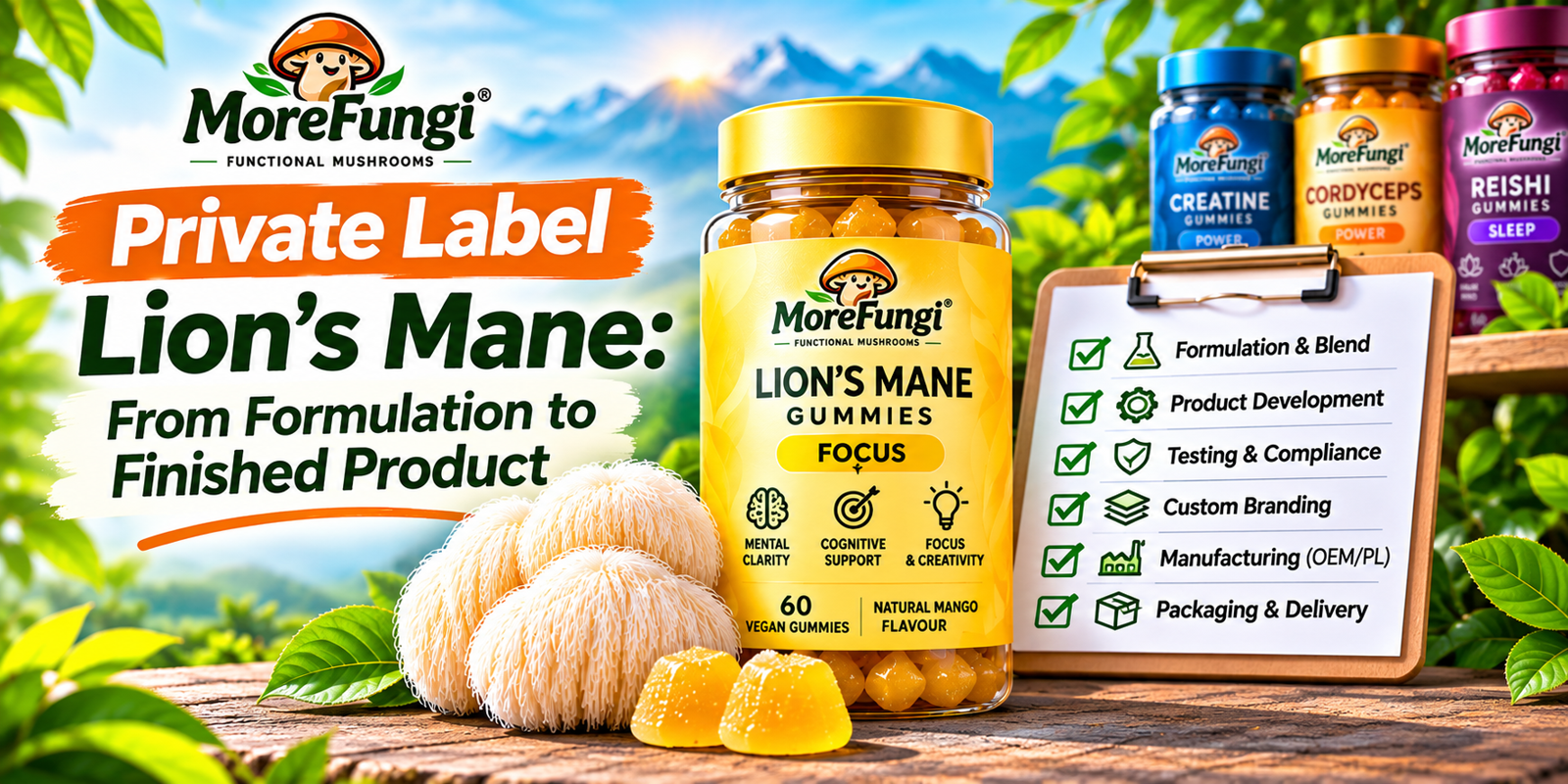
To launch a private label Lion's Mane supplement, start with a clear product concept, create a detailed development brief, select the desired format (capsules, gummies, liquid, or powder), develop a suitable formula, produce a prototype, and then move to full-scale manufacturing and packaging.
Launching a private label Lion's Mane supplement starts with an idea. Turning that idea into a finished product requires a series of carefully planned decisions involving formulation, product design, manufacturing, packaging, and logistics.
For wellness brands, supplement companies, and entrepreneurs, private label manufacturing offers a way to introduce Lion's Mane products without building a production facility from the ground up.
However, the development journey is not always straightforward.
A capsule, gummy, powder, or liquid extract may appear simple on the shelf, but each format requires different production processes, ingredient specifications, and quality controls.
Understanding these stages before production begins can help businesses control development costs, avoid unnecessary delays, and create products that meet their intended specifications.
This guide takes you through the complete development process, from the initial product brief to the finished Lion's Mane supplement ready for distribution.
1. Start With a Clear Product Concept
Every successful product development project begins with a well-defined concept.
Before discussing manufacturing, a brand needs to understand what it wants to create and who the product is intended for.
A Lion's Mane supplement designed for a premium wellness brand may require different packaging, serving formats, and positioning than a product developed for a large retail chain.
The initial concept should answer several questions:
Who is the target customer?
Which countries will the product be sold in?
What product format is preferred?
What retail price is the brand targeting?
What makes the product different from existing alternatives?
For example, a brand targeting customers who value convenience might consider a compact oral spray, while a business entering traditional supplement retail may prefer capsules.
Neither choice is automatically better.
The objective is to create a product that fits the intended customer, distribution channel, and commercial strategy.
2. Create a Product Development Brief
Once the concept is established, the next step is preparing a product brief.
This document translates the business idea into manufacturing requirements.
A practical Lion's Mane product brief typically includes the proposed formulation, serving size, packaging format, target market, expected order quantity, and desired product characteristics.
It may also include preferences such as vegan ingredients, specific capsule materials, or packaging requirements.
The more clearly these expectations are documented, the easier it becomes to assess manufacturing feasibility.
However, brands should avoid treating the first brief as a final manufacturing specification.
Ingredient availability, processing limitations, stability requirements, or regulatory considerations may require adjustments.
A good product brief defines the desired outcome while allowing room for technical development.
3. Select the Finished Product Format
The product format influences nearly every stage of development.
Different formats require different production equipment, formulation approaches, packaging materials, and testing procedures.
Lion's Mane Capsules
Capsules offer a familiar supplement format with clearly defined serving quantities.
Development involves selecting the capsule shell, determining the ingredient fill weight, and establishing whether additional processing aids are necessary.
Capsule size and the physical properties of the powder can influence manufacturing efficiency.
Lion's Mane Gummies
Gummies offer an alternative for consumers who prefer not to swallow capsules.
However, mushroom extracts may have distinctive flavors that require careful formulation.
Texture, moisture content, temperature exposure, and ingredient stability must also be considered.
A formulation that works in capsules cannot necessarily be transferred directly into gummies.
Lion's Mane Liquid Extracts and Sprays
Liquid formats require attention to ingredient solubility or dispersion, serving consistency, preservation, and packaging compatibility.
For sprays, the amount delivered per actuation should be evaluated.
The formulation must also remain suitable throughout its intended shelf life.
Lion's Mane Powders
Powders can be used as standalone supplements or incorporated into beverage blends.
Important development considerations include texture, taste, mixing behavior, and moisture protection.
Choosing the format early helps prevent expensive formulation changes later.
4. Develop the Lion's Mane Formula
With the format established, the formulation stage begins.
The development team determines which Lion's Mane ingredient is appropriate, how much will be included per serving, and whether other components are necessary.
For capsules, the objective may be a consistent powder blend that can be filled efficiently.
For gummies, the formulation may need additional ingredients to create the required texture and flavor.
Liquid products may require adjustments to achieve physical stability and accurate serving delivery.
At this stage, ingredient specifications should also be defined.
Lion's Mane ingredients can differ in their fungal material, processing methods, and composition, making it important to establish what the finished formulation is intended to contain.
The final quantity per serving should be commercially realistic, technically feasible, and appropriate for the destination market.
Marketing claims should not determine the formulation without supporting evidence.
There is no universally established Lion's Mane serving amount suitable for every product or intended purpose.
5. Move From Formula to First Prototype
A formulation written on paper is not yet a finished product.
The next stage is producing a development sample or prototype.
This allows the brand and manufacturing team to evaluate how the formulation performs in practice.
For capsules, prototype assessment may focus on fill consistency, capsule size, and powder handling.
For gummies, developers may evaluate texture, flavor, appearance, and manufacturing behavior.
For oral sprays, testing may examine spray performance, ingredient distribution, and packaging compatibility.
The first prototype may require several adjustments.
For example, a gummy may have an acceptable flavor but an unsuitable texture. A liquid formulation may initially appear stable but later develop sediment.
These issues should be addressed during development rather than after commercial production.
The purpose of prototyping is to discover practical problems before they become expensive manufacturing problems.
6. Evaluate Samples and Approve the Formulation
Once prototypes are available, the brand must decide whether the product meets its requirements.
Sample approval should involve more than personal preference.
Evaluation criteria should be established in advance and may include appearance, taste, serving consistency, packaging compatibility, and measurable technical specifications.
A development sample should also be representative of the intended commercial product.
If a prototype uses ingredients or processing methods that cannot be reproduced during manufacturing, it may create problems when production scales up.
Before approving the formula, brands should confirm which changes are still permitted and how future revisions will be handled.
An approved formulation becomes an important reference for commercial production.
7. Design Packaging That Protects the Product
Packaging development often begins alongside formulation work.
The packaging must match the product's physical characteristics and intended distribution conditions.
Capsules may be packed in bottles, while gummies can require containers that provide suitable moisture protection.
Liquid extracts and sprays need containers and closures compatible with the formulation.
Beyond product protection, packaging affects transportation, storage requirements, customer experience, and retail presentation.
Brands should also establish label dimensions, artwork specifications, print requirements, and the positioning of mandatory product information.
Labeling must be reviewed for the intended market, including applicable ingredient declarations, warnings, serving information, and permitted claims.
For European products, the regulatory status of the exact Lion's Mane ingredient and preparation should be assessed before commercial launch.
Packaging approval should cover both visual design and technical suitability.
8. Plan Stability Testing and Shelf Life
A product that performs well immediately after manufacturing may change during storage.
Stability assessments help determine whether its important characteristics remain acceptable over time.
Depending on the formulation, testing may examine:
Appearance and physical consistency.
Relevant ingredient characteristics.
Moisture or water activity.
Microbiological quality.
Packaging performance.
Changes under expected storage conditions.
For example, gummies may experience texture changes, while liquid formulations may develop separation or sediment.
Accelerated testing can provide useful development information, but it does not always replace real-time stability data.
Shelf-life decisions should be supported by an appropriate scientific rationale.
Brands should avoid assigning arbitrary expiration dates simply because competitors use similar durations.
9. Prepare for Commercial Manufacturing
Once the formulation, packaging, and relevant requirements are approved, the product can move toward commercial manufacturing.
The manufacturer must translate the development formula into controlled production instructions.
This includes defining ingredient quantities, manufacturing steps, equipment requirements, quality checkpoints, and packaging procedures.
For example, capsule production may involve blending, filling, inspection, and packaging.
Gummy manufacturing can require additional controls involving heating, mixing, depositing, cooling, and packaging.
Production processes should be appropriate to the product and comply with the applicable manufacturing requirements.
The first commercial batch may also provide valuable information about how well the formulation scales beyond development samples.
Any significant deviations should be investigated before the finished product is released.
10. Complete Finished Product Testing and Release
Manufacturing a product does not automatically mean it is ready for sale.
Before distribution, the finished batch must undergo the applicable quality review and release procedures.
These may include evaluating manufacturing records, verifying packaging and labeling, and reviewing relevant laboratory results.
The exact requirements depend on the destination market and product classification.
A batch number should allow the finished product to be traced through the relevant production records.
If a product fails established specifications, the manufacturer should investigate the issue and determine the appropriate disposition.
For US dietary supplements, FDA manufacturing rules include requirements for finished-product specifications and batch production records.
Product release should be based on documented compliance with defined requirements, not simply on the completion of production.
11. Organize Delivery and Distribution
The final production stage involves preparing the finished product for shipment.
Brands should clarify shipping terms, delivery responsibilities, product storage conditions, and the documentation needed for their destination market.
International orders may require customs information, commercial invoices, packing lists, and additional documentation depending on the product and country.
The total landed cost should be understood before ordering.
This includes not only manufacturing and packaging but also freight, duties, taxes, and handling where applicable.
Brands should also plan how inventory will be received, stored, and tracked.
A successful product launch requires that the finished supplement reaches its destination in suitable condition and with the necessary documentation.
12. Prepare for the Next Production Run
Private label product development does not end with the first delivery.
The first commercial batch provides an opportunity to assess the complete process.
Brands should review customer feedback, inventory movement, packaging performance, and any quality complaints.
Reordering should be planned early enough to account for ingredient procurement, manufacturing capacity, testing, and shipping.
If changes are needed, they should be formally reviewed rather than introduced without documentation.
Keeping accurate formulation and production records helps maintain consistency between batches.
Over time, this supports better inventory planning, more predictable costs, and reliable product availability.
Frequently Asked Questions
How long does private label Lion's Mane manufacturing take?
The timeline depends on formulation complexity, prototype revisions, packaging availability, testing requirements, and manufacturing schedules. A ready-made formula may require less development work than a fully customized product.
Can I create a custom Lion's Mane formulation?
Yes, some manufacturers offer custom formulation services. Feasibility depends on the chosen ingredients, product format, manufacturing capabilities, and applicable regulations.
Which Lion's Mane product format should I choose?
The best format depends on your target market, customer preferences, distribution strategy, and budget. Capsules, gummies, powders, and liquids have different formulation and production considerations.
Can I change my formulation after sample approval?
Changes may be possible, but they can require additional development work, testing, cost adjustments, and renewed approval before commercial manufacturing.
Final Thoughts
Creating a private label Lion's Mane product is a structured journey from concept to commercial delivery.
Each stage has a different purpose: the product brief defines the objective, formulation establishes the composition, prototyping tests feasibility, packaging protects the product, and commercial manufacturing turns the approved design into a finished supplement.
The most successful development projects are not necessarily those with the most complicated formulas or expensive packaging.
They are the projects where commercial goals, technical requirements, quality controls, and production decisions work together.
A well-planned Lion's Mane product begins with a clear idea and becomes a finished product through disciplined development, testing, manufacturing, and delivery.
Related reading
- private label manufacturing process
- extract vs powder options
- fruiting body vs mycelium
- importing Lion's Mane considerations