
Distribution
What Distributors Should Ask Before Importing Lion's Mane
By MoreFungi · 10 min read · 6 Sept 2026
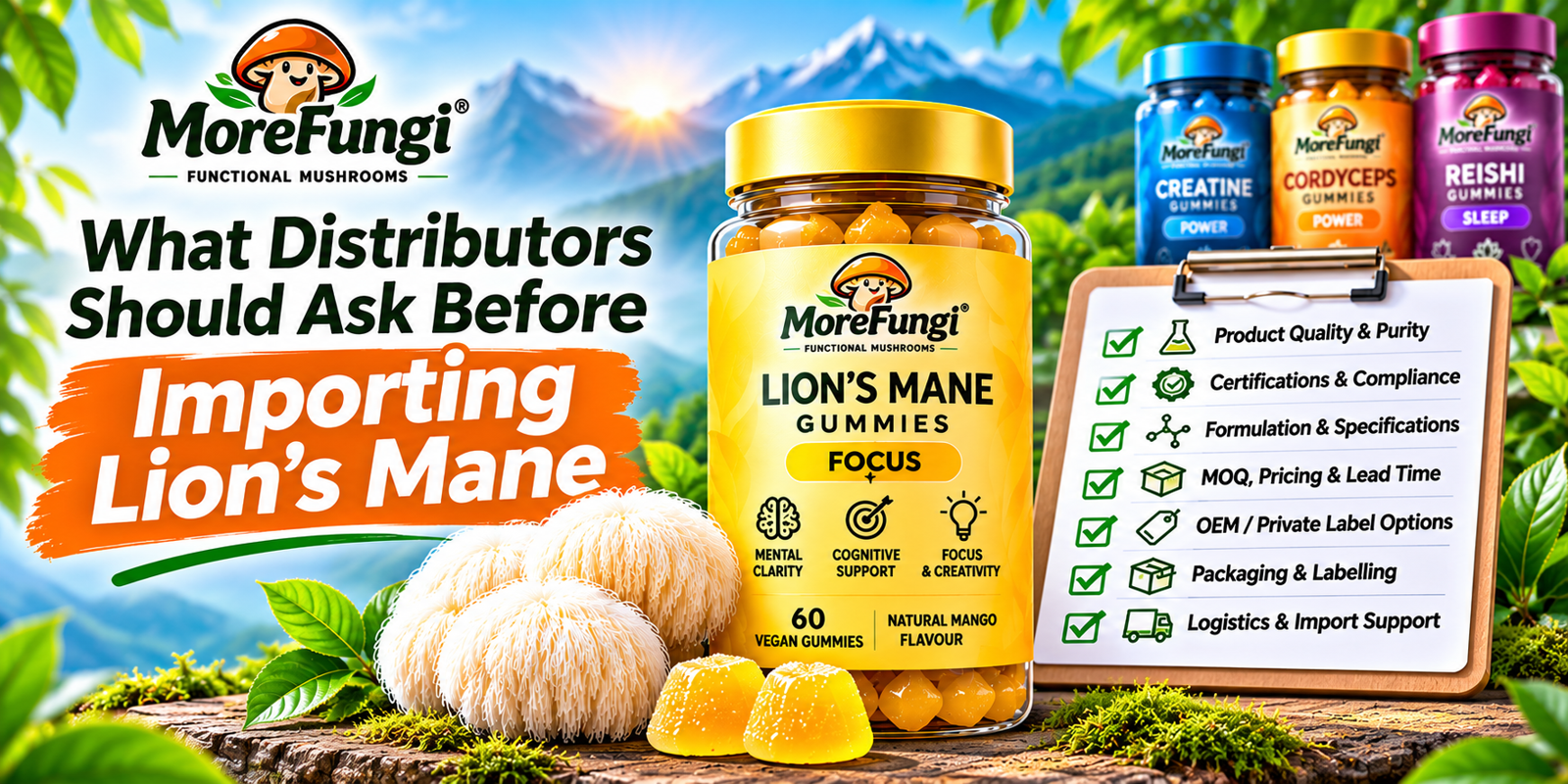
Distributors should confirm Lion's Mane’s legal status, required import documents, who bears legal responsibility, packaging compliance, and correct customs classification before importing.
Importing Lion's Mane products can create opportunities for distributors looking to expand their portfolios in the functional mushroom and wellness markets.
However, introducing a mushroom supplement into a new country involves more than negotiating a price and arranging international shipping.
Distributors must understand product classification, import regulations, customs procedures, labeling requirements, commercial responsibilities, and the true cost of bringing products into their market.
A product already being sold successfully in one country may require additional documentation, different packaging, or even regulatory authorization before it can be offered elsewhere.
Failing to investigate these requirements can result in customs delays, unexpected expenses, inventory losses, or products that cannot legally be sold.
Before importing Lion's Mane, distributors should establish whether the product is permitted in their market, what documentation is required, and whether the commercial opportunity justifies the investment.
This guide covers the essential questions to ask before placing an international order.
1. Is Lion's Mane Legal to Import and Sell in Your Country?
The first question should always concern market legality.
Lion's Mane, scientifically known as Hericium erinaceus, is an edible mushroom used in various food and supplement products.
However, its legal status is not identical in every country.
Regulatory authorities may distinguish between whole mushrooms, dried powders, concentrated extracts, mycelium, and finished dietary supplements.
For example, within the European Union, certain Lion's Mane fruiting-body preparations have been determined to be non-novel, while dehydrated Lion's Mane mycelium powder has been classified as a Novel Food.
These distinctions can affect whether a particular product can legally enter the market.
Outside Europe, countries may have different ingredient restrictions, registration requirements, or product classifications.
Questions to ask:
Is the exact Lion's Mane ingredient permitted?
Is the finished product classified as food, a supplement, or another regulated category?
Does it require registration, notification, or authorization?
Are there restrictions on dosage, ingredients, or product presentation?
Consult the relevant national food or health authority before committing to an import order.
2. What Import Documents Will Be Required?
International shipments depend on accurate documentation.
Missing or inconsistent paperwork can delay customs clearance, generate storage charges, or prevent goods from entering the destination country.
Document requirements vary according to the origin, destination, and product classification.
Common commercial documentation includes:
Commercial invoice.
Packing list.
Transport document, such as an air waybill or bill of lading.
Product description and applicable customs classification.
Country-of-origin information.
Supporting product documentation where required.
Certain destinations or product categories may require additional certificates, import permits, or official controls.
For EU imports, businesses carrying out customs operations generally need an Economic Operators Registration and Identification (EORI) number.
Before shipping, ask who will prepare each document and who will be responsible for correcting errors.
Do not assume that a supplier automatically handles every destination country's customs requirements.
3. Who Is Legally Responsible for the Imported Product?
One frequently overlooked issue is the legal responsibility of the importer.
Purchasing a product from an overseas manufacturer does not automatically transfer every responsibility to that manufacturer.
Depending on national legislation and contractual arrangements, the importer or distributor may have significant obligations concerning product compliance, traceability, labeling, and recalls.
In the European Union, food business operators have legal responsibilities for ensuring food law compliance within their activities.
Importers must also be able to identify their suppliers and maintain relevant traceability information.
Before importing, establish which business is responsible for:
Import clearance and regulatory documentation.
Product registration or notification, where required.
Label compliance and local-language information.
Storage and distribution conditions.
Customer complaints and product withdrawals.
These responsibilities should be clearly documented in the commercial agreement.
4. Does the Packaging Meet Local Market Requirements?
Packaging approved for one country may not be acceptable in another.
Importers should confirm whether the finished product can be sold with its existing label or requires modification.
Relevant requirements may include ingredient declarations, net quantity, serving instructions, warnings, responsible business information, and mandatory language requirements.
Some countries require specific supplement notifications or additional information before products can be marketed.
Distributors should also review proposed health and marketing claims.
Statements about Lion's Mane improving memory, concentration, immunity, or treating medical conditions may be restricted or prohibited without appropriate authorization.
A claim appearing on another country's product packaging does not make it legally acceptable in your market.
Request label artwork before production and have it reviewed against local requirements.
Resolving labeling problems before manufacturing is considerably easier than relabeling thousands of products after arrival.
5. What Is the Correct Customs Classification?
Every imported product needs an appropriate customs classification.
The Harmonized System (HS) provides an international framework for classifying traded goods.
However, classifications can differ depending on whether the shipment contains dried mushrooms, extracts, ingredient preparations, or finished supplements.
National customs authorities may apply additional tariff subdivisions.
Incorrect classification can result in the wrong duties being calculated, customs disputes, or delays.
Distributors should establish:
The appropriate customs code.
Applicable import duties.
Import VAT or other taxes.
Any preferential tariff treatment.
Relevant permits or restrictions.
For EU markets, the European Commission's Access2Markets portal provides information about tariffs, product requirements, and import procedures.
The final classification should be confirmed with the relevant customs authority or a qualified customs professional.
6. What Is the Actual Landed Cost?
A low purchasing price does not necessarily translate into an attractive distribution margin.
The true landed cost includes the expenses required to bring the product into your inventory.
Consider a hypothetical shipment of 5,000 Lion's Mane supplement units purchased for €4 each.
The product cost would be €20,000.
If international freight, insurance, customs duties, brokerage, and other applicable landing expenses total €5,000, the landed cost would be €25,000, or €5 per unit.
This example is illustrative, not a market quotation. Recoverable VAT and other accounting treatments may affect the final calculation.
Distributors must then account for warehousing, marketing, sales commissions, retailer margins, damaged stock, and operating expenses.
Before ordering, calculate whether the expected wholesale or retail selling price leaves enough margin after these costs.
Distribution profitability should be measured against the full commercial cost, not simply the supplier's unit price.
7. Which Shipping Terms Are Being Offered?
International shipping terms determine important responsibilities between buyer and seller.
Incoterms such as EXW, FCA, FOB, CIF, and DDP are commonly used in international trade, although not every term is appropriate for every transport arrangement.
For example, under EXW, the seller generally makes goods available at the named premises, leaving substantial collection and transportation responsibilities to the buyer.
Under DDP, the seller assumes extensive delivery and import-clearance obligations, subject to the agreed terms and applicable legal requirements.
The practical difference can significantly affect the buyer's workload and financial exposure.
Before agreeing to shipping terms, clarify:
Who arranges international freight?
Who purchases insurance?
Where does transportation risk transfer?
Who handles customs clearance?
Who pays duties and taxes?
Use the applicable Incoterms rule with a clearly named place and version in the contract.
8. How Much Inventory Should You Import Initially?
Importing too much inventory can create unnecessary financial pressure.
Lion's Mane products have shelf-life limits, and sales performance in a new market may be uncertain.
A distributor should consider the expected monthly sales volume, retail onboarding schedule, storage capacity, and reorder lead time.
For example, importing 10,000 units while only expecting to sell 500 units monthly could create excessive inventory exposure.
However, ordering too little may lead to stock shortages if demand develops faster than anticipated.
Ask about minimum order quantities, production lead times, repeat-order schedules, and the minimum remaining shelf life guaranteed upon delivery.
A smaller initial shipment may be sensible when testing a new market, provided the economics remain workable.
9. Is There a Clear Distribution Agreement?
Commercial expectations should be established before significant money is invested.
Some manufacturers offer exclusive distribution rights for specific countries, while others work with several distributors in the same market.
Exclusivity can create opportunities but may also involve purchase commitments or performance requirements.
A written distribution agreement should address:
Territory and permitted sales channels.
Exclusivity, if applicable.
Pricing and payment terms.
Minimum purchase commitments.
Agreement duration and termination.
Branding and intellectual property rights.
Responsibilities for defective products and recalls.
Distributors should also clarify whether the manufacturer can sell directly to retailers or consumers within the agreed territory.
Never assume that becoming the first importer automatically grants exclusive rights.
10. What Happens if a Shipment Has Problems?
Even carefully planned international shipments can encounter difficulties.
Products may arrive damaged, customs clearance may be delayed, or an unexpected quality issue may be discovered.
Distributors should understand how these situations will be managed before the first shipment leaves the factory.
Questions worth asking include:
What happens if products arrive damaged?
How quickly must shipment problems be reported?
Who pays for replacements or returns?
What happens if a batch is rejected?
How are product recalls coordinated?
Is appropriate insurance maintained?
The supplier and importer should agree on complaint procedures, evidence requirements, and financial responsibilities.
Clear procedures protect both parties and reduce the likelihood of disputes.
11. Can the Product Compete in Your Local Market?
Regulatory clearance is only one part of a successful import strategy.
Before committing to distribution, evaluate whether there is genuine commercial demand.
Research competing Lion's Mane products, local retail prices, consumer purchasing behavior, and available sales channels.
Potential distribution channels include supplement retailers, pharmacies where permitted, health stores, online marketplaces, and wellness-focused businesses.
Consider whether your product offers a meaningful advantage in formulation, packaging, price positioning, or brand identity.
Also investigate retailer listing fees, distributor margins, promotional requirements, and marketing costs.
A legally compliant product can still become an unsuccessful investment if the market cannot support its intended selling price.
12. What Should Happen Before the First Commercial Order?
Once regulatory and commercial requirements are understood, the final step is preparing an import plan.
A sensible sequence is:
Confirm the legal status of the exact product.
Review labeling and required documentation.
Establish the customs classification and import costs.
Calculate realistic wholesale and retail margins.
Agree on shipping, payment, and distribution terms.
Evaluate samples and available product documentation.
Confirm inventory quantities and delivery schedules.
Arrange customs clearance and local warehousing.
Do not release a significant payment solely because a supplier offers an attractive discount.
The first order should be supported by clear documentation, realistic financial calculations, and a defined route to market.
Frequently Asked Questions
Can Lion's Mane supplements be imported into the European Union?
Certain Lion's Mane preparations are permitted from a Novel Food perspective, but the exact ingredient, processing method, product classification, and other applicable requirements must be assessed. Not every Lion's Mane preparation has identical regulatory status.
Do distributors need an import license?
Requirements depend on the importing country and product category. Some destinations may require licenses, registrations, notifications, or additional certificates.
What is the biggest financial risk when importing Lion's Mane?
Common risks include unsold inventory, unexpected logistics costs, regulatory delays, insufficient retailer margins, and product non-compliance.
Can distributors import Lion's Mane under their own brand?
Yes, private-label arrangements may be possible. However, branding, manufacturing, labeling, intellectual property rights, and import responsibilities must be agreed upon before production.
Final Thoughts
Importing Lion's Mane products offers commercial opportunities, but successful distribution requires more than identifying an attractive supplement.
Distributors must understand the regulations of their target market, prepare accurate import documentation, calculate realistic landed costs, and establish clear commercial responsibilities.
A well-structured distribution agreement and realistic inventory plan can also reduce unnecessary financial exposure.
The most important question is not simply whether Lion's Mane can be imported, but whether the specific product can be imported legally, distributed profitably, and supported reliably over time.
By answering these questions before placing an order, distributors can make better purchasing decisions and establish a stronger foundation for international growth.
Related reading
- fruiting body vs mycelium
- extract vs powder considerations
- wholesale packaging requirements
- supplier selection criteria
Sources
- Consultation process on novel food status - Food Safety
- Hericium erinaceus, a medicinal fungus with a centuries-old history: Evidence in gastrointestinal diseases
- Economic Operators Registration and Identification number (EORI) - Taxation and Customs Union
- Food law general requirements - Food Safety - European Commission
- Food supplement notification in the EU: country by country