Product knowledge
Fruiting Body vs Mycelium: What B2B Buyers Should Understand
By MoreFungi · 9 min read · 6 Sept 2026
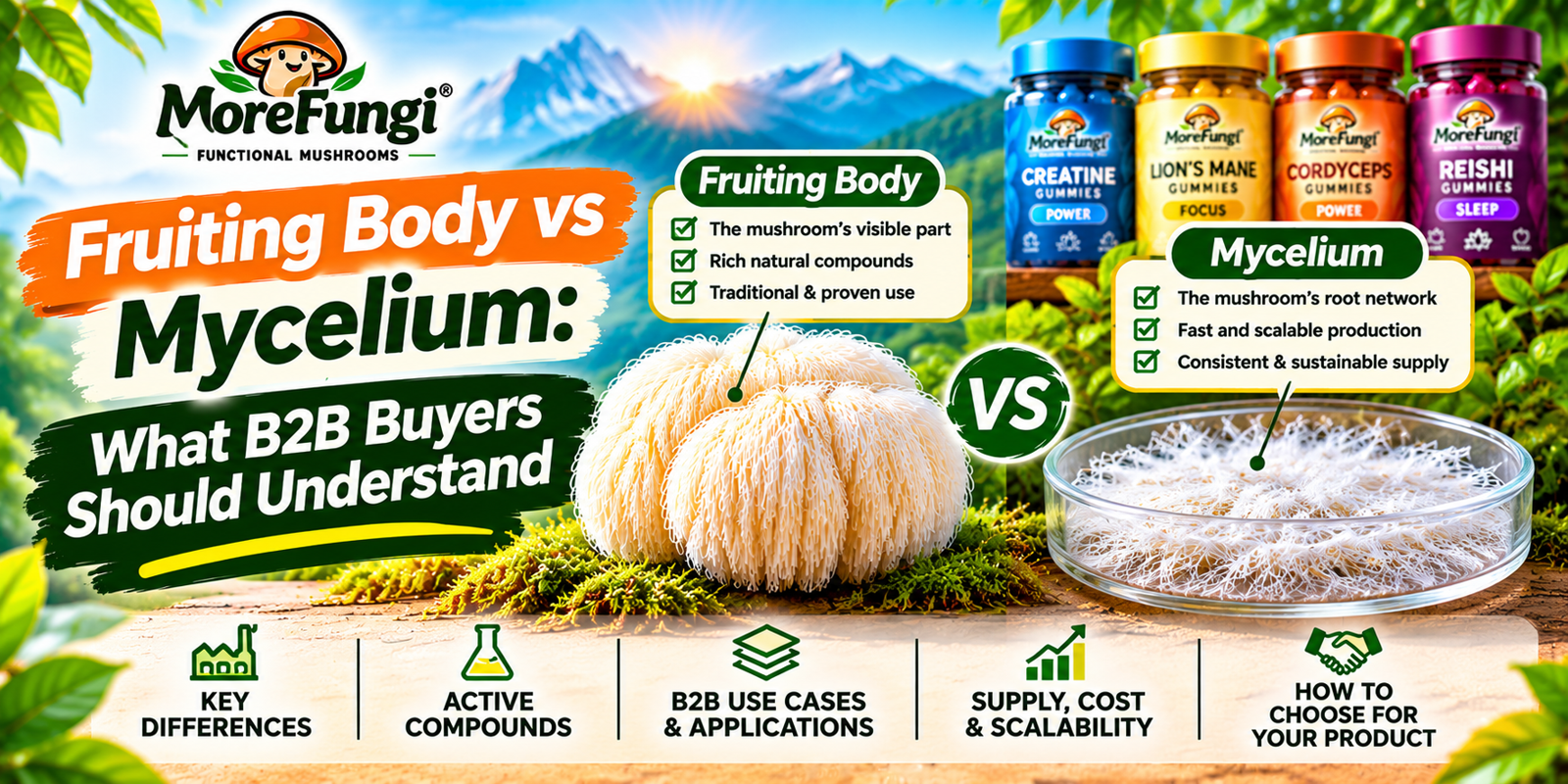
B2B buyers should evaluate the actual compound profile, cultivation method, and labeling clarity of both fruiting body and mycelium ingredients, rather than relying on marketing claims, to ensure the product meets their specifications.
When purchasing functional mushroom ingredients, one question appears repeatedly: should you choose fruiting body or mycelium?
For supplement brands, wholesale distributors, and private-label manufacturers, the answer can influence ingredient composition, product specifications, labeling, regulatory requirements, and purchasing decisions.
Unfortunately, the debate is often oversimplified.
Some suppliers promote fruiting bodies as the only legitimate source of functional mushroom compounds. Others argue that mycelium offers superior properties because certain substances can be produced during controlled cultivation.
Neither position tells the complete story.
Both fruiting bodies and mycelium are natural parts of fungi. Their chemical compositions can differ, and the suitability of either material depends on the mushroom species, cultivation method, processing conditions, and intended application.
For B2B buyers, the most important consideration is not which material sounds better in marketing, but what the ingredient actually contains and whether it meets the product's requirements.
This guide explains the biological differences, commercial considerations, and documentation buyers should understand before purchasing.
1. What Is a Mushroom Fruiting Body?
The fruiting body is the reproductive structure produced by certain fungi.
It is the visible mushroom most people recognize, such as the distinctive cascading white structures of Lion's Mane or the fan-shaped structures of Turkey Tail.
Fruiting bodies develop from an established mycelial network when environmental conditions support their formation.
In commercial production, these structures may be harvested, dried, milled, or processed into extracts.
Fruiting-body ingredients are common in the functional mushroom industry, particularly in products containing Lion's Mane, Reishi, Shiitake, and Turkey Tail.
Their chemical composition varies by species, cultivation environment, maturity, and processing method.
For buyers, the term fruiting body identifies the fungal material used, but it does not independently establish ingredient purity, compound concentration, or product effectiveness.
A poorly handled fruiting-body ingredient can still have quality problems.
2. What Is Mushroom Mycelium?
Mycelium is the network of microscopic fungal filaments, called hyphae, that grows through a nutrient source.
It is responsible for absorbing nutrients and supporting fungal growth.
Unlike fruiting bodies, mycelium can be cultivated without producing a visible mushroom.
Commercial mycelium cultivation may use liquid fermentation or solid substrates, depending on the species and intended ingredient.
Controlled cultivation can offer advantages such as predictable production environments and opportunities to target particular fungal compounds.
However, mycelium ingredients are not all manufactured in the same way.
Some consist of separated fungal biomass, while others contain mycelium together with the material on which it was cultivated.
This distinction is particularly important when evaluating commercial mushroom powders.
3. Mycelium vs. Myceliated Grain: An Important Difference
One of the most overlooked distinctions in functional mushroom purchasing is the difference between cultivated mycelium and myceliated grain.
Myceliated grain is produced when fungal mycelium grows through a grain-based substrate, such as rice or oats.
Depending on the manufacturing process, the entire cultivated material may be dried and milled without removing the remaining grain.
The resulting ingredient can contain both fungal biomass and grain-derived carbohydrates.
That does not automatically make the ingredient unsafe or unusable.
However, it means the composition may differ substantially from isolated mycelium or fruiting-body material.
For example, residual starch may contribute to the product's total carbohydrate content.
Buyers should never assume that an ingredient labeled "mycelium" consists entirely of fungal biomass.
Ask whether the growing substrate remains in the final material and whether its contribution has been characterized.
Transparent ingredient descriptions are essential for fair product comparisons.
4. Do Fruiting Bodies and Mycelium Contain Different Compounds?
Yes. Different fungal structures can contain different concentrations of naturally occurring compounds.
However, the differences are species-specific and can be influenced by cultivation and processing.
Lion's Mane provides an interesting example.
Researchers have investigated compounds called hericenones, associated primarily with fruiting-body material, and erinacines, particularly associated with certain mycelial preparations.
These compounds have attracted scientific interest because of findings in laboratory and animal studies.
However, their presence does not automatically establish clinical effectiveness in humans.
Not every Lion's Mane fruiting-body product contains meaningful quantities of specific hericenones, and not every mycelium ingredient contains measurable quantities of the erinacines highlighted in research.
Production conditions and analytical verification matter.
Similar complexity exists with other functional mushrooms.
Different Reishi preparations, for example, may have different triterpenoid and polysaccharide profiles.
A scientific study involving one mushroom preparation should not automatically be used to support claims about another.
5. What Role Do Beta-Glucans Play?
Beta-glucans are important structural polysaccharides found in fungal cell walls.
They are frequently measured in commercial mushroom ingredients and can provide useful information about product composition.
However, beta-glucan concentration varies between ingredients.
It should not be assumed that every fruiting-body powder has more beta-glucans than every mycelium ingredient.
Equally, a high total polysaccharide percentage does not necessarily indicate high beta-glucan content.
This matters particularly when grain-based substrates are involved.
Grain starch can contribute carbohydrates that appear in broader polysaccharide measurements.
For meaningful comparisons, buyers should request beta-glucan testing conducted using an appropriate analytical method.
Alpha-glucan results may provide additional information, although they cannot independently determine the exact proportion of fungal biomass and residual grain.
The best approach is to evaluate compositional data together with manufacturing information.
6. Does Fruiting Body Automatically Mean Higher Quality?
No.
Although some marketing materials present fruiting-body ingredients as inherently superior, quality cannot be established solely by identifying the fungal structure.
A fruiting-body ingredient may be poorly dried, improperly stored, contaminated, or inaccurately described.
Likewise, a carefully cultivated mycelium ingredient may have consistent and well-characterized composition.
A fair comparison requires equivalent criteria.
These include ingredient identity, measurable composition, contamination controls, processing methods, and product consistency.
It is also important to understand the intended application.
A manufacturer developing a product around a particular mycelium-associated compound may have different technical requirements from a food brand using whole dried mushroom material.
Fruiting bodies and mycelium are not universally interchangeable.
The appropriate choice depends on what the product is designed to contain.
7. Why Cultivation Methods Matter
Cultivation methods can influence the final ingredient before processing even begins.
Fruiting bodies are commonly grown on suitable agricultural or wood-based substrates, depending on the mushroom species.
Environmental conditions such as temperature, humidity, nutrition, and harvest timing can affect development.
Mycelium may be cultivated through solid-state processes or liquid fermentation.
Liquid fermentation can allow controlled production of fungal biomass, but the resulting composition still depends on the strain, nutrients, cultivation conditions, and harvesting process.
For grain-based cultivation, buyers should understand how much substrate remains in the commercial ingredient.
Production consistency is particularly important when purchasing large volumes for repeat manufacturing.
A supplier should be able to explain the cultivation system and how it maintains consistent specifications between batches.
8. Regulatory Differences B2B Buyers Must Consider
Fruiting bodies and mycelium may have different regulatory status in the same market.
This is especially important for businesses selling products in the European Union.
For example, European Commission Novel Food consultations have distinguished certain Lion's Mane fruiting-body preparations from dehydrated Lion's Mane mycelium powder.
The latter received a Novel Food determination, while specified fruiting-body preparations have received non-novel determinations.
These decisions demonstrate why fungal material and manufacturing processes must be identified precisely.
However, a non-novel determination for one preparation does not automatically authorize every preparation, concentration, or product containing the species.
Businesses must evaluate the exact ingredient, intended use, and applicable requirements.
Regulatory status may also differ outside Europe.
Importers and product developers should complete a market-specific assessment before approving commercial production.
9. How Should Buyers Compare Ingredient Prices?
Price comparisons can be misleading when different fungal materials are sold under similar product names.
Consider two hypothetical ingredients.
One consists of dried Lion's Mane fruiting-body material. Another contains mycelium cultivated on grain, including residual substrate.
Even if both are marketed as Lion's Mane powder, their compositions may differ.
Comparing their prices per kilogram without reviewing specifications may therefore lead to inaccurate conclusions.
Buyers should consider the usable ingredient composition, relevant analytical markers, required serving quantity, and manufacturing suitability.
Additional factors include minimum order quantities, storage requirements, product consistency, and regulatory costs.
A lower price may represent good value for a suitable ingredient.
Alternatively, it may reflect differences in composition that make the material unsuitable for the intended product.
The most relevant comparison is between ingredients meeting the same clearly defined requirements.
10. Questions to Ask Before Purchasing
Before approving fruiting-body or mycelium ingredients, B2B buyers should establish exactly what they are buying.
Ask the following questions:
What is the complete scientific name of the fungal species?
Does the ingredient contain fruiting body, mycelium, or both?
How was the fungal material cultivated?
Was grain or another substrate used during cultivation?
Does the final ingredient contain residual substrate?
Which compounds or compositional characteristics are measured?
Can the supplier explain the analytical methods used?
Are product specifications consistent between batches?
Is the exact ingredient suitable for the intended regulatory market?
Does the supplied documentation accurately describe the commercial material?
These questions help establish a technical basis for purchasing decisions.
They also reduce the risk of comparing products that appear similar but contain substantially different materials.
Frequently Asked Questions
Is fruiting body better than mycelium?
Not universally. The most suitable fungal material depends on the species, intended formulation, ingredient composition, and available evidence.
Is mycelium the same as myceliated grain?
No. Mycelium refers to fungal biomass. Myceliated grain may contain both fungal material and the grain substrate on which it was cultivated.
Does fruiting-body material always contain more beta-glucans?
No. Beta-glucan concentrations vary between species, cultivation methods, processing conditions, and individual products.
Can B2B buyers use both in one formulation?
Potentially, provided the ingredients are suitable for the intended application and comply with applicable regulations. Their proportions and specifications should be clearly documented.
Final Thoughts
The fruiting body versus mycelium debate is often presented as a choice between good and bad ingredients.
That is not an accurate representation of fungal biology or commercial manufacturing.
Both materials can be legitimate ingredients, but they may differ in composition, production methods, and regulatory status.
For B2B buyers, the critical distinction is between clearly characterized ingredients and products marketed without sufficient transparency.
Understanding exactly which fungal material is being purchased is more valuable than choosing a side in the fruiting body versus mycelium debate.
The strongest purchasing decisions are based on product-specific evidence, accurate ingredient descriptions, and suitability for the intended market.
Related reading
- wholesale requirements
- choosing a supplier
- private-label manufacturing process
- extract vs. powder comparison
Sources
- Exploring the Critical Environmental Optima and Biotechnological Prospects of Fungal Fruiting Bodies
- Functional Mushroom Market Size, Share, Growth & Report 2031
- Mycelium vs. Fruiting Bodies of Edible Fungi—A Comparison of Metabolites
- The Influences of Different Mixing Methods for Fungi and Substrates on the Mechanical and Physicochemical Properties of
- What Are Myceliated Oats | Real Mushrooms
- Harnessing the power of resistant starch: a narrative review of its health impact and processing challenges